
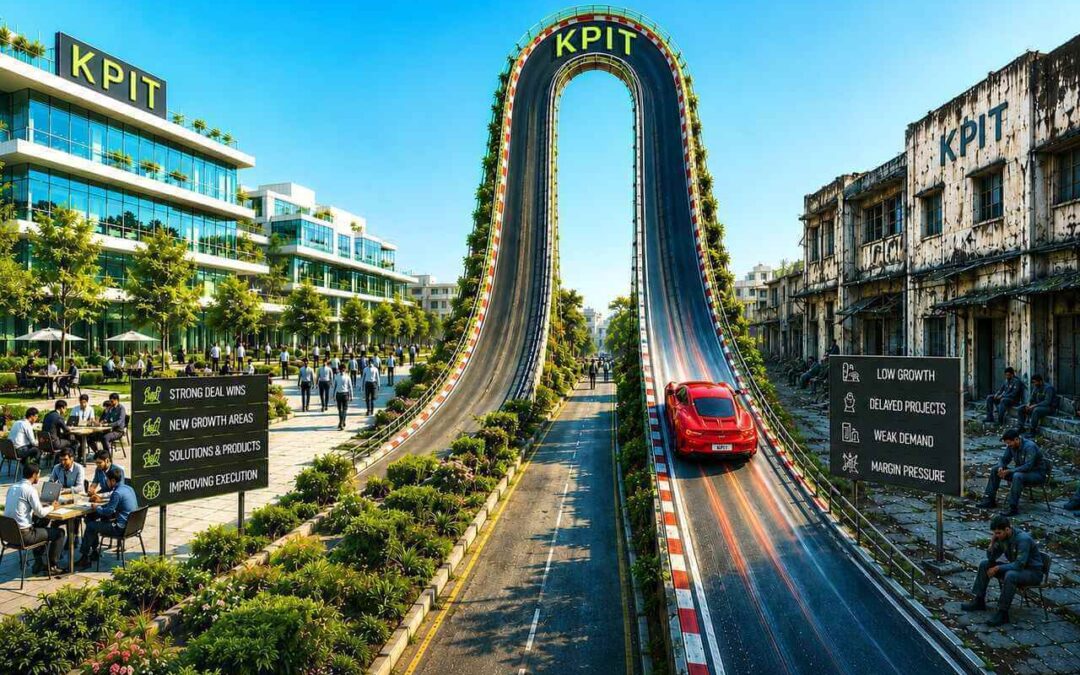
Synopsis: KPIT Technologies has spent the past year explaining why growth slowed, from delayed OEM programs to a major business model transition. With the stock down nearly 60 percent from its peak and new growth areas beginning to emerge, will Q1 finally show that the slowdown has bottomed out and recovery is taking shape?
The global automobile industry is going through a major technology shift. Cars are no longer only about engines, body design and fuel efficiency. They are increasingly becoming software-driven machines, with features such as connected services, digital cockpits, advanced driver assistance, cybersecurity, cloud-based updates and software-defined vehicle platforms becoming more important. This is the space where KPIT Technologies has built its identity over the years.

However, the stock market has not treated the company kindly in the recent past. KPIT Technologies had made its high of around Rs. 1,928 in July 2024. It is now trading in the range of Rs. 730 to Rs. 770, which means the stock has fallen around 60 percent from its peak.
For a company that was once one of the market’s favourite plays on electric vehicles and software-defined vehicles, this fall shows that investors are no longer only looking at the long-term story. They now want to see whether the numbers are improving.

The question before Q1 is simple. Can KPIT finally show signs of a turnaround, or will investors again hear the same explanation of delayed programs, weak passenger vehicle spending and near-term transition pain?
Why Did The Growth Slow Down?
KPIT’s FY26 was not a collapse, but it was clearly a weak year compared to the kind of growth investors had got used to. In Q1 FY26, management said year-on-year growth was 12.8 percent in rupee terms and 7.8 percent in dollar terms. EBITDA remained strong at 21 percent, and management sounded confident that the second half would be better than the first half. The company also spoke about strong pipeline, AI-based mobility solutions, China, India and commercial vehicle opportunities.

But as the year moved forward, the picture became more complicated. In Q2 FY26, management gave a clearer explanation of why deal wins were not fully translating into revenue growth. It said there had been a revenue reduction of around USD 65 million over time. Out of this, around USD 45 million came from customers deprioritising or delaying old programs, while around USD 20 million came from KPIT’s own solution-led approach cannibalising some existing revenue. In simple terms, new deals were coming, but a part of those wins was only replacing revenue that was getting lost elsewhere.
This is an important point. If a company is winning new business but old programs are slowing down at the same time, headline deal wins may not immediately show up as strong revenue growth. That is exactly what happened with KPIT during FY26.
The Passenger Vehicle Problem
The biggest area to watch is passenger vehicles. KPIT’s long-term story is still linked strongly to global carmakers. However, this is also the part of the business that has faced pressure. PL Capital noted that passenger cars declined 0.2 percent quarter-on-quarter in Q4 FY26, marking the third consecutive quarterly decline. At the same time, passenger cars still contributed around 76.5 percent of KPIT’s revenue.

That means the company’s largest business vertical is not yet showing a clear recovery. Commercial vehicles and off-highways have grown well, but they are still much smaller compared to passenger cars. This creates a simple problem. The new growth segments are improving, but the main engine has not fully restarted.
Motilal Oswal also highlighted that passenger car demand remains soft globally, especially among legacy Western OEMs, with delays and cancellations in new platform programs. This is not necessarily a company-specific problem. It is more about how global automakers are managing spending in a difficult environment. But for KPIT, the impact is real because its business depends heavily on these OEM technology programs.
Why Profit Did Not Grow With Revenue
Another concern is that revenue growth has not translated into strong profit growth. For FY26, KPIT’s revenue grew 10.5 percent in rupee terms. However, PAT declined. Motilal Oswal noted that revenue and EBIT grew in FY26, but adjusted PAT declined 13.9 percent year-on-year. PL Capital also showed that adjusted PAT declined 16.6 percent in FY26. This means the issue is not only revenue. The quality of profit also matters.
There were multiple reasons for this. Depreciation and amortisation moved higher. Other income and forex-related items hurt the bottom line. The company also continued to invest in technology, AI, products, leadership and acquisitions. EBITDA margin stayed around the 20.6 percent to 21 percent zone during the year, but EBIT margin and net margin were weaker.
This is why investors are not getting excited by revenue growth alone. If sales increase but net profit does not grow, the market starts asking whether the new business model is really improving economics or only helping the company defend revenue.
The New Strategy
KPIT is clearly trying to change its business model. The company is moving from a pure engineering services model to a solutions and products-led model. Management has spoken repeatedly about fixed-price contracts, reusable assets, AI-led delivery, validation platforms, middleware, cybersecurity, cloud-based connected services and software-defined mobility solutions.
In Q4 FY26, management said products and solutions already formed around 21 percent of the total pipeline. Products and solutions currently contribute around 15 percent of revenue and management is targeting this mix to rise meaningfully over the next three years. PL Capital also highlighted that KPIT wants solutions and products to become a much bigger part of revenues by 2029.
The idea is simple. Instead of billing only for engineers and time, KPIT wants to build more reusable tools, platforms and solutions. If this works, it can improve margins and reduce the link between headcount and revenue. But this transition also creates near-term pain. Management itself has admitted that AI-led solutions can cannibalise some existing services revenue in the short term.
Will Q1 Be Strong Enough For A Turnaround?
The answer may depend on what the market defines as a turnaround. If the expectations are a sharp recovery in growth, Q1 could still disappoint. Both Motilal Oswal and PL Capital highlighted that KPIT is entering FY27 with some known headwinds. Two large software-defined vehicle programs are ending during the first half of FY27, while passenger vehicle spending remains weak across several global automakers. Both brokerages also reduced their near-term growth estimates after the Q4 results, suggesting that FY27 could remain a transition year rather than a full recovery year.
At the same time, there are reasons to believe the business may be approaching a more stable phase. KPIT exited FY26 with its strongest deal wins in several quarters, including large engagements in software-defined mobility and off-highway vehicles. The company also reported growth in trucks, off-highway vehicles, connected services and cloud-based solutions, indicating that some of its newer growth areas are gaining traction.
The bigger question is whether these businesses are now large enough to offset the weakness in the passenger vehicle segment. Passenger cars still account for the majority of KPIT’s revenue and the segment has reported three consecutive quarters of decline. As long as this segment remains weak, it becomes difficult for the company to return to the kind of growth rates market had become used to in earlier years.
There is also the issue of the company’s ongoing business model transition. Management has repeatedly stated that KPIT is moving from a traditional engineering services model towards a solutions and products-led approach. While this could improve margins and create a stronger competitive position over time, both management and brokerages have acknowledged that the transition is creating near-term disruption in some legacy middleware and services programs.
As a result, Q1 may not deliver the kind of numbers that immediately signal a complete turnaround. However, if the company can show that passenger vehicle declines are moderating, large deal wins are converting into revenue, and newer segments such as off-highway, connected services and solutions continue to grow, it could strengthen the argument that FY26 represented the bottom of the slowdown rather than the beginning of a longer period of weak growth. In other words, Q1 may be less about proving that KPIT has fully turned around and more about proving that the business is finally moving in the right direction.
Conclusion
KPIT’s long-term opportunity in automotive software still exists. Software-defined vehicles, ADAS, connected services, cloud platforms, cybersecurity and digital cockpits remain important areas for global automakers. The company also appears to be taking the right strategic steps by moving towards products, solutions, AI-led delivery and new adjacencies such as off-highway and commercial vehicles.
However, the stock’s sharp fall shows that investors are no longer willing to value KPIT only on future potential. FY26 raised an important question: can the company’s new growth engines grow fast enough to offset weakness in its traditional passenger vehicle software business?
That is why Q1 FY27 matters. A strong quarter may not be about one big revenue number. It may be about whether passenger cars stabilise, whether deal wins convert into execution, and whether margins hold despite continued investments. After a year of explanations, KPIT now needs the numbers to speak louder than the strategy.
Disclaimer: The views and investment tips expressed by investment experts/broking houses/rating agencies on tradebrains.in are their own, and not that of the website or its management. Investing in equities poses a risk of financial losses. Investors must therefore exercise due caution while investing or trading in stocks. Trade Brains Technologies Private Limited or the author are not liable for any losses caused as a result of the decision based on this article. Please consult your investment advisor before investing.