
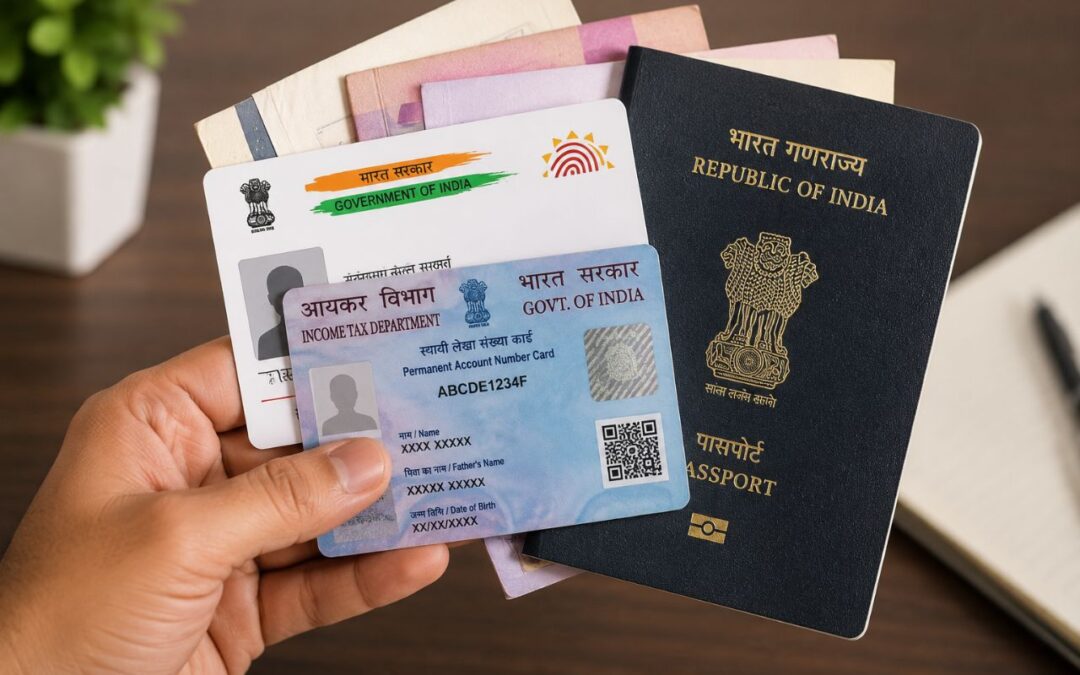
Synopsis: In India official government documents come with fixed fees set by respective departments, ranging from free services like Voter ID and Aadhaar enrollment to paid ones like passports and PAN cards. This article lists the approximate 2026 official fee for each major document to help applicants plan and avoid overpaying intermediaries.
Whether you’re applying for an identity proof such as PAN and Aadhaar, or birth, caste and income certificates, as an Indian citizen, you frequently need to procure government documents for finance, legal, and administrative-related matters. Each of these comes with an official fee, and varies depending on the state. Below is a document-wise list of existing government fees.
1. PAN Card
A new physical PAN card costs ₹107 for applicants. Applying for an instant e-PAN through the Income Tax e-filing portal using Aadhaar is completely free.
2. Passport
A new or reissued 36 page passport under the normal category costs ₹2,500, while the Tatkal category costs ₹5,000, for a 60 page passport costs ₹3,500 under normal processing and ₹6,000 under Tatkal.
3. Voter ID Card
Enrolling for a Voter ID card, including corrections or address updates, is completely free of charge through the Election Commission’s portal or local electoral offices.
4. Aadhaar Card
Enrolment is free for new Aadhaar. For demographic updates like, name, address, or mobile number costs ₹75, while a biometric update including fingerprint, iris, or photograph costs ₹125.
5. Birth Certificate
Fresh issuance of a birth certificate typically costs between ₹10 and ₹50, and depends on the municipal corporation or panchayat handling the registration.
6. Death Certificate
A death certificate generally costs ₹20 to ₹50. The exact amount is set by the issuing local municipal or civic authority.
7. Caste Certificate
Caste certificates are usually free or available for a nominal fee, depending on the state government’s revenue department rules.
8. Income Certificate
An income certificate costs ₹10 to ₹50 and is issued by the local tehsildar or revenue office after verification of income details.
9. Domicile Certificate
A domicile certificate costs between ₹20 and ₹100, and the fee is set by the respective state’s revenue or general administration department.
Also Read: ITR Filing Deadline 2026: Only 5 Days Left Till July 31 – Key Things to Recheck Now
10. Marriage Certificate
Registering a marriage and obtaining the certificate usually costs from ₹50 to ₹100, and is payable at the local marriage registration office.
11. Driving Licence (Learner’s)
A learner’s licence costs ₹150 to ₹200, and also covers the application and the online traffic rules test conducted by the RTO.
12. Driving Licence (Permanent)
A permanent driving licence costs around ₹200 to ₹700, which includes the application fee and the practical driving test at the RTO.
13. RC Book (New Vehicle)
Registering a new vehicle and obtaining its RC book costs around ₹300 to ₹1,500, depending on the vehicle category and state specific charges.
14. RC Transfer
Transferring vehicle ownership through an RC transfer typically costs ₹300 to ₹500, based on the vehicle type and the RTO’s fee schedule.
15. No Objection Certificate (NOC)
An NOC, such as for vehicle relocation to another state, generally costs ₹100 to ₹500 depending on the issuing RTO.
16. EWS Certificate
The Economically Weaker Section (EWS) certificate is usually free or available for a nominal fee through the local revenue office.
17. Ration Card
Ration cards are typically free to obtain, though some states charge a small nominal fee depending on local rules.
18. Senior Citizen Card
Senior Citizen ID cards are issued free of cost by most state governments and municipal bodies for residents above the eligible age.
19. Disability Certificate
A disability certificate is usually free or available for a nominal fee, issued after medical assessment at a government hospital or board.
20. Migration Certificate
Commonly needed for educational transfers, a migration certificate costs around ₹100 to ₹500 depending on the issuing board and the university.
21. Trade Licence
Trade licence fees vary by business type and municipal jurisdiction, as local bodies set charges based on the nature and scale of the business.
Verifying Fees Before You Pay
Since many of these documents are processed through both online portals and local offices, it helps to confirm the exact applicable fee directly on the official website before making payment.
- Check the respective department’s portal, such as Parivahan Sewa for driving licences and RC, UIDAI for Aadhaar, Passport Seva for passports, and NSDL/UTIITSL for PAN.
- Local certificates like birth, death, caste, income, and domicile certificates are usually processed through state-specific e-governance portals where fee schedules are listed.
- Always ask for an official receipt when paying at a physical centre, since verified payments are traceable and help avoid disputes later.
- If using a facilitation centre or agent, confirm their authorisation status, as unauthorised intermediaries sometimes charge above the prescribed government fee.
All in all
Fees for government documents in India in most cases is very negligible and for few like Aadhaar and Voter ID card, enrolment and Senior citizen cards are completely free. Knowledge of accurate government fees on specific documents helps the applicants to save from paying excessive charges to the agents or through facilitation centres for government documentation.