Synopsis: Bengaluru’s most historic neighbourhoods reflect the evolution of the city over almost five centuries. This article covers the top oldest areas of Bengaluru and their growth.
The story of Bengaluru dates back to almost 500 years ago when Kempegowda built a fort in Pete area. These old localities, from their ancient trading streets to the British Cantonment as well as the planned neighbourhoods have set the tone to the creation of the city that we know today. While Bengaluru has transformed to become a Silicon Valley of India, these neighbourhoods still have the ability to retain its heritage while being among the most desired localities in which to live, work and visit the city.
1. Pete Area (Kempegowda’s Bengaluru)
The Pete area, which is the oldest neighbourhood in Bengaluru, was founded in 1537 by Nadaprabhu Kempegowda I. It is situated in the Central part of Bengaluru and the city was planned as a fortified trading town having inter-connected markets catering to individual trades. Other villages like Chickpet, Cottonpet, Balepet, Nagarathpet and Doddapete developed into prosperous trading centres. In the present times, despite the speedy urbanization, the Pete area is among the busiest wholesale trading centers for Bengaluru, retaining the richness of the city’s trading heritage and historic character.
2. Basavanagudi
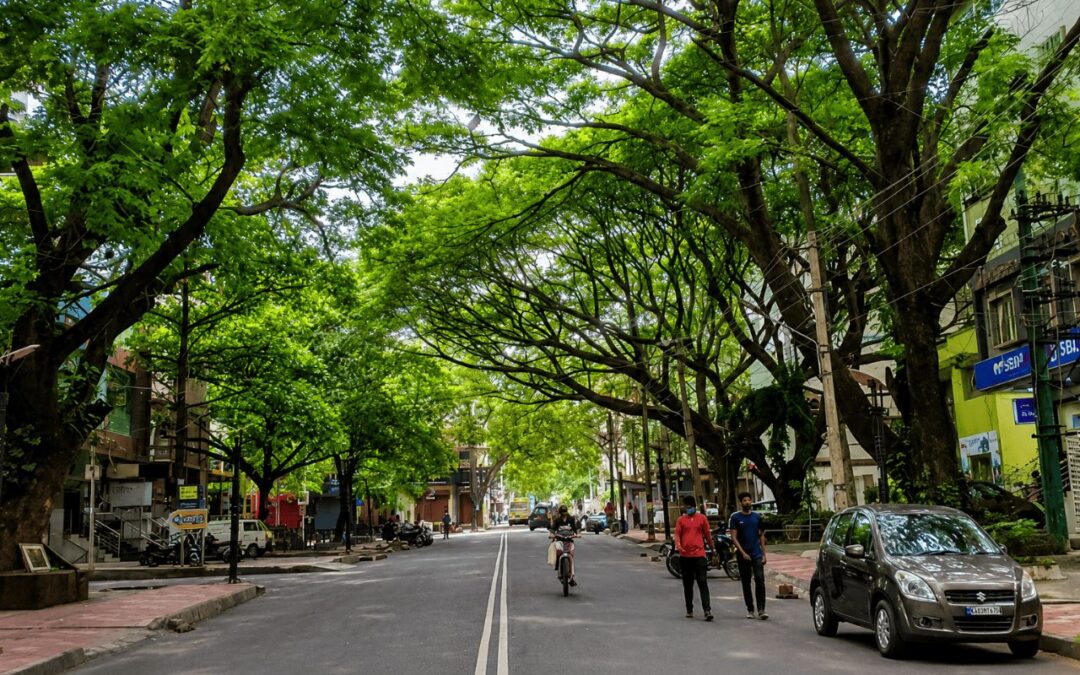
Established in 1898, Basavanagudi is one of Bengaluru’s oldest planned residential neighbourhoods, developed after the plague epidemic. It is situated in South Bengaluru and is named after the popular Dodda Basavana Gudi (Bull Temple) and has several notable sites such as Gandhi Bazaar and Bugle Rock Park. With its tree-lined streets, heritage homes and vibrant cultural scene, Basavanagudi continues to be one of the city’s most sought-after residential localities while retaining its old-world charm.
3. Malleswaram
Malleswaram was established in 1889, as a planned extension to the town of Basavanagudi after the plague hit. Located in the north-western part of Bengaluru, it is surrounded by the historic Kadu Malleshwara Temple and the bustling 8th Cross Market and the old-timey restaurants. Today, Malleswaram, a perfect fusion of history, culture and modernity, has become one of the most sought after neighbourhoods in Bengaluru.
4. Shivajinagar
Shivajinagar is one of Bengaluru’s oldest and busiest commercial neighbourhoods that dates back to the British Cantonment era (early 1800s). It sits in the heart of the city of Bengaluru, and grew up as a trading and residential centre for the Cantonment. Famous for its historic churches, mosques and bustling bazaars, Shivajinagar is still a vibrant multicultural region, which retains the city’s diverse past while remaining an important commercial hub.
5. Cantonment
The Bengaluru Cantonment was established in 1809 by the British East India Company and grew into a separate military and administrative township to the east of an old Pete area. It marked the introduction of wide roads, colonial architecture and planned layouts and spanned portions of present-day MG Road, Brigade Road, Richmond Town, Frazer Town and Cox Town. Today, the Cantonment still has its colonial feel, and is one of the city of Bengaluru’s top commercial and residential areas.
6. Halasuru (Ulsoor)
Halasuru (Ulsoor) is in East Bengaluru, and has the historic Someshwara Temple and the picturesque Ulsoor lake, which is one of the biggest lakes in Bengaluru. Today, Halasuru is a blend of centuries-old heritage with modern life, and is well connected with MG Road, Indiranagar and Central Business District.
7. Jayanagar
Jayanagar, which was developed in 1948, is one of the first planned residential areas of independent India. It is situated in the South of Bengaluru and is designed with space for parking, wide roads and blocks and parks to handle the population. Today, Jayanagar is known as one of the best established and sought after neighbourhoods of Bengaluru due to its immaculate civic amenities, shopping places, educational places and green spaces.
8. Rajajinagar
Rajajinagar was set up in 1949 as a planned residential and industrial development of West Bengaluru. The locality is named after the last Governor-General of India, C. Rajagopalachari (Rajaji), with wide roads, parks and organised residential blocks. Although Rajajinagar was once known as a slum area, it has now evolved into a well-established neighbourhood with good connectivity, educational facilities and business & industrial centers.
9. Chamarajpet
Chamarajpet was one of the early planned neighbourhoods in Bengaluru established in 1892 after Chamaraja Wadiyar X. It is situated in South-West Bengaluru, and was laid out with layouts and became an important residential and commercial district. Chamarajpet is known for its old houses, old markets, educational institutions and has good connectivity with the old commercial heart of the city today.
10. Gandhi Bazaar
Gandhi Bazaar is one of the most iconic traditional markets in Bengaluru, which came up as a part of the Basavanagudi extension in the early part of the 20th century. Located in South Bengaluru, it is renowned for its flower, fruit and vegetable markets, age-old eateries and festive atmosphere. The Gandhi Bazaar still stands today as a lively cultural and commercial landmark, retaining the ambiance of the old city of Bengaluru and catering to the generations who have passed by.
Why do older neighbourhoods perform better than newer layouts?
Though there is a lot of development going on in the outskirts of Bengaluru, a number of the historic areas still have some benefits which the newer neighbourhoods have yet to catch up.
- Drainage systems: Older “localities” were laid out with a good stormwater drainage system and are typically less prone to flooding than many newly constructed areas.
- Reliable water supply: Water connections in established neighbourhoods have been in place for a long time and this decreases the need for private tankers.
- Organised layouts: Well laid out roads, as well as separate civic spaces make these areas easier to navigate and less chaotic.
- Planned infrastructure: Schools, hospitals, markets, parks and public transport services are all very well established, as opposed to many developing suburbs.
- Abundant greenery: Decades-old trees offer more shade, lower temperatures and a more pleasant environment.
- Excellent connectivity: proximity to the Central Business District, Metro stations and major roads which helps to minimise commute time.
Conclusion
Bengaluru’s oldest neighbourhoods like the Pete area, Basavanagudi and Malleswaram have survived years of development. The city has been growing with IT developments and expansions but these historic localities are its base, its legacies are what made the city of Bengaluru what it is today.