
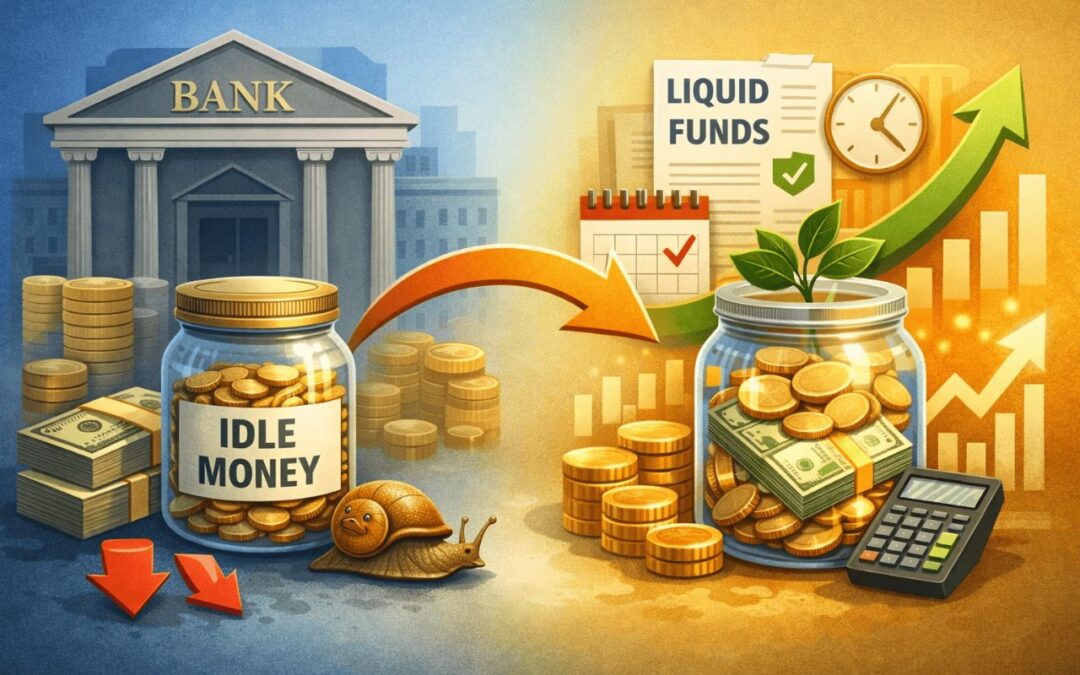
Synopsis: The savings bank account interest rate averages between 2.5 – 3.5% in major public sector banks and the inflation in India in the last one decade has persisted between 3 to 8%. So, every single day, the money lying in the bank account is losing its value. This article discusses six reasons to move your idle money to liquid funds to manage your cash efficiently.
Liquid mutual funds invest predominantly in highly liquid money market and debt securities of very short tenure and hence provide high liquidity. They invest in T-Bills, Commercial Paper (CP) and Certificate of Deposits (CD). Savings bank accounts at most major banks are currently offering 2.5%-3.5% per year. Liquid mutual funds are delivering 6.5%-7.5% per year in 2026 with nearly accessibility and better flexibility. Six reasons why smart investors are making this move:
Large Return Gap
A corpus of ₹5,00,000 sitting idle at a savings account at 3% earns you ₹15,000 a year. Liquid fund at 7% earns ₹35,000 which is a difference of ₹20,000 annually. Compounded over 3-5 years the gap becomes bigger and unlike equity investments their returns come from short-term debt instruments like treasury bills, commercial papers and deposit maturing within 91 days.
Fast Withdrawal (Within 1 Working Day)
Fixed Deposits offer better rates than savings account but they penalize you if left early. Liquid funds have no such restriction and there is no lock-in period. There is no lock-in period and only a small exit load if you redeem within 7 days of investment. FDs charge a penalty (often 0.5-1% interest reduction) for breaking the tenure early.
Liquid Mutual Funds Have Low Risk
Liquid mutual funds maintain safety and high liquidity ideal for short term. As they are invested in low risk debt instruments like Commercial papers, Certificate of Deposits, Treasury Bills as it is investing in shorter duration assets. Liquid mutual funds invest in high credit rating debts like Sovereign Debt which is backed by government or AAA equivalent.
Ideal Spot Before Putting into Equity
Investors love liquid funds and it rarely gets talked about as when you receive a bonus, annual payout that is intended to be invested in equity should not be let sit in savings account instead to be put in a liquid fund which could then be set up against a Systematic Transfer Plan (STP) that gives you a cost averaging on equity while the corpus still continues to grow. This is one of the underused combinations in personal finance.
Also read: Top 6 Alternatives to Fixed Deposits That May Offer Better Returns in 2026
Works Across Every Financial Goal
Savings account just lets your money sit idle and earns the same low rate with no structure. Liquid funds let you create purpose driven buckets with better returns. Liquid funds work for most of the things that includes emergency corpus, travel fund, down payment savings, quarterly advance tax, payment reserves as there is no minimum investment period and no penalty for withdrawing. You don’t need a different account for each goal.
Higher Pre-Tax Returns
Liquid funds generally offer higher pre-tax returns (6-7%) than bank savings accounts (2.5-3.5%) but are taxed as STCG based on your income tax slab for investments made after April 1, 2023. Liquid funds typically offer returns of 6-7%, which is higher than what is generally offered by savings accounts. Even after paying taxes at your slab rate, the higher base return usually results in better net returns than a savings account.
In conclusion, liquid funds are not complex investment. They are an upgrade on your money that sits idle offering double returns of a savings account with no lock-in and same tax structure. If you have money sitting in savings account that is not marked for any payment in the next seven days then it is to be considered to move it to liquid funds.
Written by Vijai Krishna