
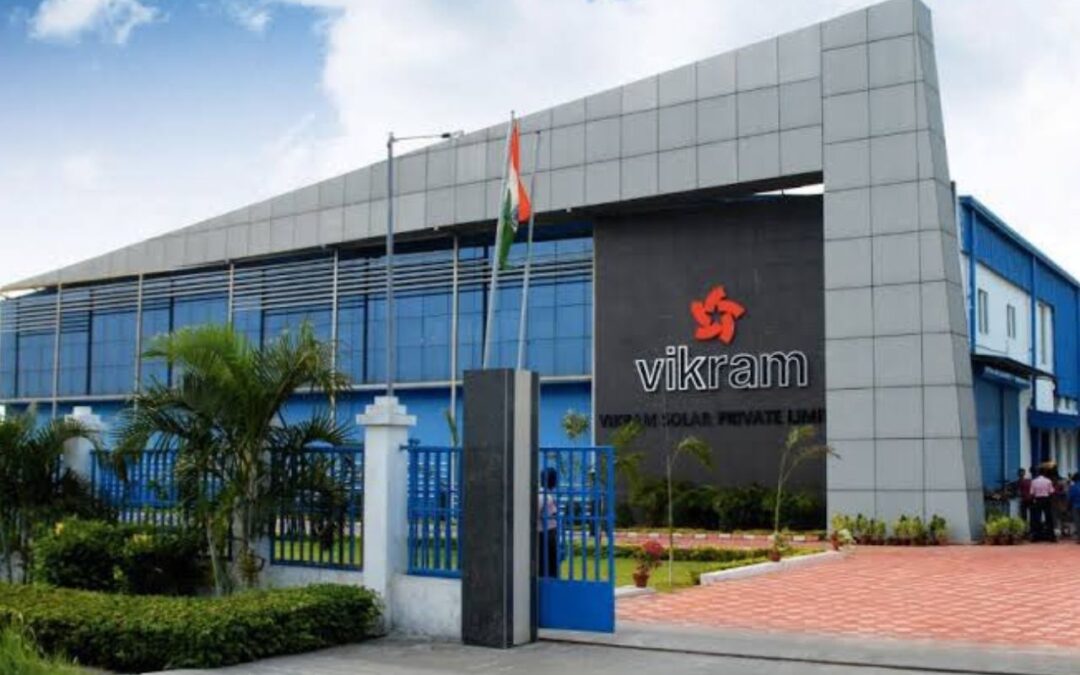
Synopsis: Vikram Solar’s greenfield first PV module plant is commissioned at Gangaikondan, in Tamil Nadu’s Tirunelveli district and is expected to generate around 1,500 skilled jobs and forms part of the company’s broader push toward integrated solar manufacturing.
Vikram Solar has commissioned its latest manufacturing unit at Gangaikondan in India. This becomes the fourth manufacturing facility of the company. It has three facilities in Tamil Nadu and one in Falta, West Bengal. The company aims to increase its manufacturing capacity in view of the domestic and international market demands.
About the Gangaikondan Facility
- Location: Gangaikondan, Tirunelveli district, Tamil Nadu
- Type: Greenfield facility
- Size: Spread across 6 lakh sq ft
- Employment: Expected to generate jobs for over 1,500 skilled professionals
- Technology: Combines automation with digital manufacturing systems
- Key features: Real-time production tracking and automated quality checks at every stage in the facility
- Objective: Designed to minimise manual intervention and maximise precision, hence ensuring reliable module performance over decades
What the Plant Will Produce
This new facility in Gangaikondan will manufacture Vikram Solar’s Hypersol N-Type TOPCon G12R modules. The modules are designed with outputs ranging from 615 and 640 Wp of power and module efficiency of up to 23.69%. The facility has been built in accordance with industry specifications and will be Vikram Solar’s state-of-the-art plant with modern and advanced automated production technologies.
Also read: BDA-Approved KGF E-City Crest: Why This Premium Project Near Electronic City is Worth Considering
Leadership’s Perspective
The Chairman and Managing Director of Vikran Solar, mentioned this as a crucial milestone of the company and is essential for the company’s future growth. This investment is a part of a longer-term plan to add cell, wafer, and ingot production at the same site, and making it more aligned with India’s domestic requirements and strengthening the country’s solar supply chain.
Expansion Roadmap
Vikram Solar has laid out an aggressive capacity expansion plan alongside the Gangaikondan rollout,
This phased build-out is intended to move Vikram Solar toward a fully integrated, self-reliant manufacturing ecosystem, from ingots and wafers through to finished modules, reducing dependence on imported components and reinforcing India’s broader clean energy manufacturing goals.
Tamil Nadu: The Emerging Manufacturing Hub
With Gangaikondan now operational, Tamil Nadu hosts three of Vikram Solar’s four manufacturing plants, alongside existing facilities at Oragadam and Vallam, making the state the anchor of the company’s production capacity, while its fourth plant remains at Falta, West Bengal.
Strategic Significance
Vikram Solar’s Gangaikondan facility complements the company’s manufacturing capabilities and signals a broader push by India’s solar giants to localise the full value chain rather than rely solely on module assembly. Amid India’s rapid push for clean energy, the increased demand for locally sourced solar components and modules means such plants are set to be critical in reducing import reliance and supporting India’s self-reliant renewable energy sector.
All in all
With the Gangaikondan facility now operational, Vikram Solar has strengthened its manufacturing base to four plants across two states, adding both capacity and jobs to India’s solar ecosystem. As the company works toward its FY27-FY30 capacity targets, the Tamil Nadu plant is set to become a key contributor to Vikram Solar’s integrated manufacturing ambitions and India’s domestic solar supply chain.