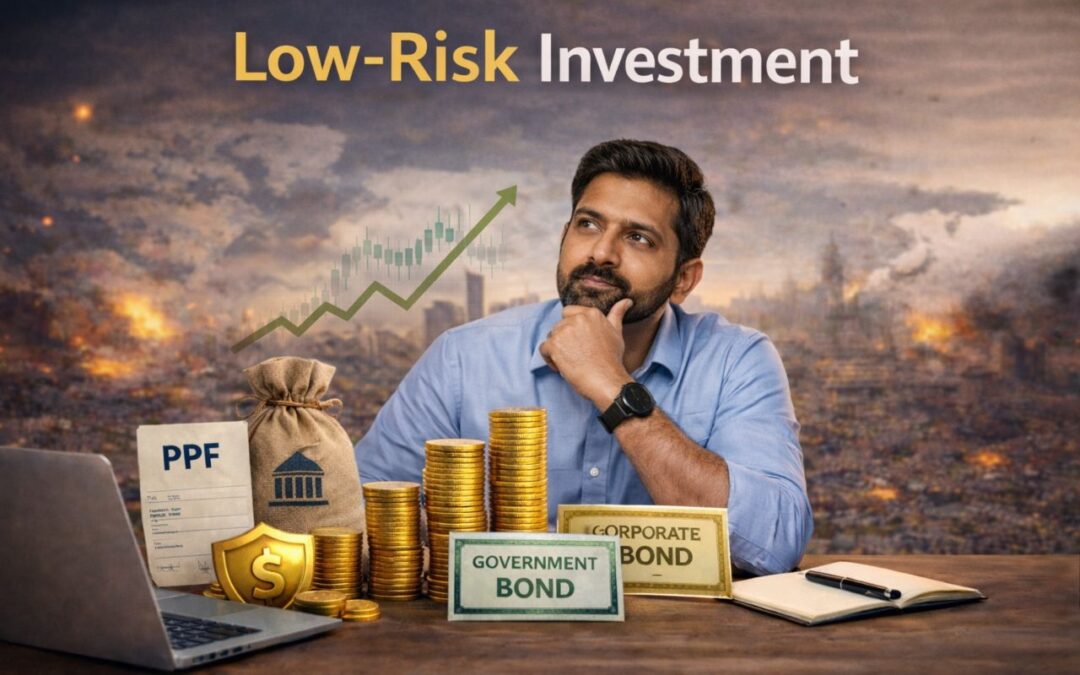
Synopsis: Your assets face danger during wars and political conflicts and economic crises, yet they can remain secure. Here are the best 6 low-risk investments that safeguard your money and deliver consistent earnings, and maintain your financial security through all market conditions. The preservation and protection of your wealth can be achieved through government bonds, fixed deposits, gold, corporate bonds, secure mutual funds and a public provident fund.
The world experiences major losses to financial markets when international wars, political conflicts and economic downturns occur. Investors during these times of uncertainty prefer to invest in safe assets that protect their capital while creating stable returns.
During economic downturns, investors need to choose safe investment options that will help them keep their wealth intact since these investments will safeguard their funds against market volatility. Your financial future will suffer permanent damage if you fail to learn wartime and crisis investment methods.
Why Low-Risk Investments Matter During Uncertain Times
Investors seek to safeguard their capital because financial markets show unpredictable behaviour during times of war and geopolitical conflicts and economic downturns. Safe investments help preserve capital and provide stability during market downturns, while liquid assets allow quick access to cash in emergencies.
The 2008 global financial crisis and other similar crises led investors to buy government bonds as their preferred safe-haven asset. These investments, along with fixed deposits, have historically helped protect wealth during periods of market uncertainty.
Criteria for Choosing Low-Risk Investments
The security of “safe” investments varies between different investment options, which requires investors to learn about the necessary security features. The main elements that investors need to assess include the following factors:
- Capital Preservation – Your main objective should be to safeguard the total amount of your investment. The primary goal of low-risk instruments lies in protecting your capital instead of pursuing high investment returns.
- Liquidity – Select investment options that enable you to obtain your cash swiftly when emergency situations arise or market conditions suddenly shift.
- Inflation Protection – Your investment needs to achieve growth that matches inflation rates while you protect your capital.
- Government-Backed or Insured – The combination of government-backed investments with insured investments from trustworthy organizations creates a dual protection system that reduces the likelihood of financial loss.
The implementation of this safe investment checklist guarantees your portfolio will maintain its strength throughout financial and political emergencies. Low-risk investing criteria will enable investors’ choice of secure investment options, decreasing their exposure to market fluctuations while protecting their capital.
Top 6 Low-Risk Investments
1. Government Bonds and Sovereign Debt
- Government bonds are considered very low-risk investments because they are backed by the sovereign government.
- Requires people to protect their capital while generating a consistent income.
- Provides stable returns that investors can depend on.
- It protects portfolio value during times when market prices experience unpredictable changes.
- Allow investors to add gold-linked bonds, which act as a protection mechanism against inflation.
- Examples include Treasury bonds and sovereign gold bonds.
- In 2026, the interest rates range between 6% and 7% per year, depending on maturity and market conditions.
- It has medium liquidity because investors can sell it in secondary markets, but they must hold it until maturity to receive its full value.
2. Fixed Deposits (FDs)
- The bank-backed investment offers investment securities with an extremely safe guarantee, as it is covered by the Deposit Insurance and Credit Guarantee Corporation (DICGC) with a maximum amount of ₹5 lakh.
- Guaranteed interest income, which protects the original capital.
- It offers fixed interest rates, which extend from one month to ten years.
- Low risk because the principal amount remains protected.
- The banking service requires less work from customers because it enables them to create accounts with simple procedures.
- The strongest protection comes from banks that have received top ratings from their customers for using fixed deposits.
- In 2026, FD interest rates vary around 6% and 8% p.a., depending on the bank and tenure.
- Premature withdrawal is usually allowed but may attract a small penalty depending on the bank.
3. Gold & Precious Metals
- The asset maintains its high safety level because it has always been viewed as a secure investment.
- It serves multiple functions: it protects investors from inflation, currency depreciation, and geopolitical risks.
- Protects wealth for investors through wartime and crisis periods and market downturns.
- Investors can sell their assets at any time because the asset maintains high liquidity.
- This strategy helps investors build their portfolio through asset allocation, which decreases their overall investment risk.
- Access to different gold investment options, which include physical gold, digital gold, and gold ETFs.
- Gold returns historically have averaged around 5–10% over long periods. But due to recent market fluctuations, it has given higher returns compared to 2023-24.
- Sovereign Gold Bonds pay a fixed 2.5% annual interest (paid semi-annually) in addition to gold price appreciation.
- Investors experience high liquidity, which applies to both digital gold and ETFs.
Also Read: Tax-Saving FD vs NSC: Which Safe Investment Option Gives You Better Returns?
4. High-Quality Corporate Bonds
- The organization seeks to achieve its goals through investment in AAA- and AA-rated companies, which present minimal risk of default.
- It helps to achieve steady returns that provide safety to investors while outpacing government bonds during particular periods.
- Provides investors with returns that exceed government bond yields.
- Investors can receive regular income through interest payments.
- Investment adds diversity to the fixed-income investments that make up a portfolio.
- Indian Large corporations and financial institutions issue corporate bonds
- Average returns from investments in India during 2026 will range between 6% and 8% per year.
- The bonds provide medium liquidity because investors can sell them in secondary markets, although their value will change with interest rate movements.
5. Safe Mutual Funds (Debt & Liquid Funds)
- The safety assessment shows a medium-high rating because the operation maintains controlled management, which results in minor market fluctuations.
- The objective is to generate consistent returns that provide better liquidity than bonds and fixed deposits.
- Lower danger for investors when compared to equity mutual funds.
- It can be converted to cash easily, which makes it suitable for both temporary financial needs and urgent situations.
- The managing team helps investors to avoid making incorrect investment choices.
- The expected investment returns in India for the year 2026 will reach a range between 5% and 7% on an annual basis.
- The asset can be converted to cash with high liquidity because it allows transactions to occur within a period of 1 to 2 days, particularly for liquid funds.
6. Public Provident Fund (PPF)
- The Indian government provides complete security, which results in almost no possibility of defaulting on payment obligations.
- It aims to achieve capital appreciation while providing tax advantages and maintaining secure investment protection.
- Gives fixed returns, which increase through compound interest.
- It provides complete security of principal funds, which makes it the best choice for protecting capital.
- The tax benefits provide deductions according to Section 80C, which allows deductions up to ₹1.5 lakh per year.
- It creates an incentive for people to save money through a structured savings plan that requires them to maintain their savings for an extended period.
- The interest rate is 7.1% p.a., tax‑free, compounded annually with interest compounding every year, and the government updates the rate every three months.
- It requires a 15-year commitment, which enables investors to make partial withdrawals starting from the seventh year of their investment.
Comparison Table
Why These Investments Are Useful During War and Uncertainty
- People should invest in these assets because they provide protection for their original investment when wars, geopolitical conflicts, and economic disasters cause market crashes.
- Emergency situations require people to use gold, mutual funds, and FDs because these assets deliver immediate cash to them.
- Government bonds, PPFs and corporate bonds provide investors with consistent returns during market fluctuations.
- Gold and specific bonds function as inflation protection assets, which enable people to maintain their purchasing strength during times of rising prices.
- People can reduce their investment risks and strengthen their investment portfolio through the combination of FDs and bonds, gold and mutual funds, and PPF.
- PPF and government-backed investment options provide people with safe wealth growth that continues throughout their entire life.
Key takeaway: The combination of these low-risk investments will protect your wealth because you can access your funds while your assets will keep growing during periods of market instability.
Conclusion
Priority during unpredictable situations should be to achieve safety and stability. Your wealth protection through government bonds, FDs and gold, and corporate bonds, safe mutual funds, and PPF will also provide you with liquid assets and consistent financial returns. You should start making low-risk investments today because they will help you protect your financial security against all future challenges.
Written by Ameet S
Disclaimer: This article is for informational purposes only and does not constitute financial advice. Investment returns and risks may vary depending on market conditions, and readers should conduct their own research before making investment decisions.