
Synopsis: UPI is growing into an international digital payment system beneficial for Indian travelers. While this will further offer a much more convenient transaction abroad, travelers must understand its availability, the applicable charges, the implemented transaction boundaries, and possible cybersecurity concerns before relying on it overseas.
The UPI payment system in India runs across the urban and rural areas of the country, and has recorded a YoY growth of 30%, as of April 2026. It also holds a 49% of share in global real-time volume, as of 2025, which makes it world’s largest real-time payment system in terms of transaction volume acknowledged by the International Monetary Fund (IMF). Its expansion in the foreign markets will enhance the convenience but users should remain aware of the accepted countries, forex conversion costs, country-wise acceptance limits, and the transaction safety while using UPI internationally.
Foreign Countries Where UPI Payments Works
India has partnered with around several countries and 9 such destinations allow access to UPI payments, but the extent of acceptance varies while some countries support the UPI widely, while others offer it only at selected stores or only tourist locations:
- Singapore
- United Arab Emirates
- France
- Bhutan
- Nepal
- Sri Lanka
- Mauritius
- Qatar
- Cambodia
Steps to Use UPI During Foreign Travel
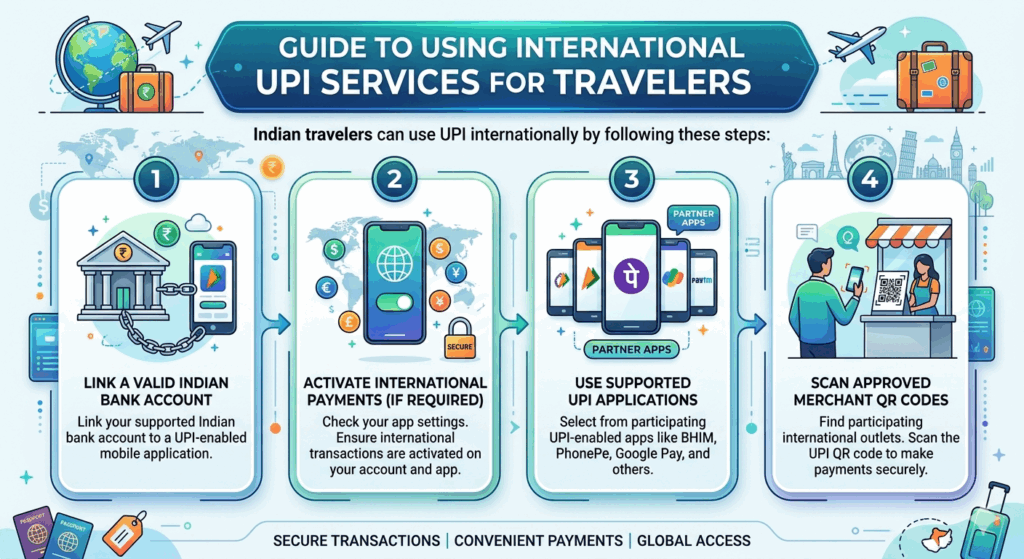
Travellers can generally use UPI internationally by following these common steps:
- Link a valid India Bank account to the UPI-enabled application.
- Ensure functionality of international payment is activated if it is eligible on the application.
- Use the supported applications such as, BHIM, PhonePe, Google Pay, or PayTM.
- Scan the merchant QR codes at the eligible international outlets.
The payment amount is usually converted into the Indian currency and is deducted directly from the linked account.
Charges Associated with Overseas UPI Transactions
International transactions usually involve additional expenses such as currency conversion charges, the bank-specific fees, international processing fees, and the foreign exchange markup fees. The cost structure usually varies according to the banks and the payment platforms, but as it uses third party applications, the costs are claimed to be virtually as low as zero or 0.4%. Travellers are advised to view their banks for these accurate details.
Also read: Top 5 States Leading India’s Monthly UPI Transactions of ₹29.9 Lakh Crore in May 2026
Transaction Limits Applicable on International UPI Usage
International UPI payments remain subject to the policies of NPCI and RBI regulations. In most cases, the standard daily transaction limit remains up to ₹1 lakh, but selected categories may allow higher limits. Benefits of International UPI Access-
- Access to UPI abroad reduces physical cash dependency
- The payments are faster through scanning the QR code
- The direct bank integration helps to enhance the safety of the system
- It is easier for small-value everyday transactions during travel
Risks to Consider
- Check the QR codes before scanning as there may be a chance of fake QR codes.
- Transactions on a unsafe public internet connections must be avoided
- Never disclose OTPs and Pins
- Enable all the transaction notifications and alerts
- Always keep backup payment options in case of unprecedented emergencies.
All in all
The expansion of our own indigenous payment system has made overseas digital payments more convenient for Indian travellers. However, international usage should be done very cautiously. Carrying additional payment options alongside UPI continues to be the most prudent approach during foreign travel.
Written by Jahnavi