

Synopsis: In this article, we explore a structural shift in 2025, where Hyderabad is outpacing Bengaluru by attracting a larger number of Global Capability Centers (GCCs) with Hyderabad hosting higher number of GCCs compared to Bengaluru and explain the reasons behind Hyderabad’s growing advantage.
India saw a sharp jump in new Global Capability Centres (GCCs) in 2025, with Hyderabad overtaking Bengaluru as the top destination for fresh centres between January to November. Till November, roughly 85-95 new GCCs in this period, of which Hyderabad alone captured over 41+ centres, while Bengaluru added around 30+ and cities like Chennai and Pune added 5+ each.
New GCCs (Jan- Nov)
1. Hyderabad, Telangana
In 2025, Hyderabad is leading and has attracted over 41 GCCs, including major companies such as:
Vanguard (Financial Services): Opened its first India GCC in Hyderabad in November 2025, targeting about 300 hires by end 2025 and scaling to more than 2,300 engineers by 2029. The hub focuses on cloud modernisation, data analytics, AI/ML and cyber security, with Vanguard’s global CIO calling the move a “talent play rather than a cost play,” underlining India’s role in high end product engineering rather than just low cost support.
McDonald’s Global Office (QSR/F&B): Inaugurated in October 2025 as the company’s largest office outside the US, spread over about 1.56 lakh sq ft in HITEC City, with capacity for 1,200-1,500 employees across data, technology, HR and finance. Telangana ministers highlighted that this GCC will act as a global innovation and enterprise hub and also support allied sectors like real estate, services and logistics in Hyderabad.
Multiple other GCCs: Others companies like Eli Lilly (the establishment of a tech and innovation center connected to a different USD 1 billion manufacturing investment in the city), Sonoco (the setting of a USD 10 million GCC and finance center of excellence), Heineken (the region of Asia pacific GCC for tech and shared services) and Netflix (the establishment of a creative-tech or post-production hub in HITEC city). Are emerging GCCs in Hyderabad.
2. Bengaluru, Karnataka
Bengaluru keeps on drawing in top notch technology and cybersecurity work, yet its proportion of new GCCs in 2025 is less than Hyderabad’s.
Deepwatch: A US-based cybersecurity firm has taken over its operations in India by establishing a new Bengaluru GCC committed to AI-driven managed detection and response (MDR), cloud security, and R&D, which also indicates the firm’s unwavering faith in the city’s extensive engineering talent.
Rakuten: The Japanese e-commerce giant announced a minimum investment of $100 million in India and a significant share for Bengaluru devoted to Fintech, E-commerce, and Technology.
Bengaluru will still be the most developed market of India, especially in product engineering, chip-design, and multi-functional large hubs defining the country.
Also read: Latest GCC Launches in India: Key Cities Fueling Commercial Real Estate Demand in 2025
3. Chennai, Tamil Nadu
Chennai continued pulling in the magnets of the GCC in 2025, especially in the areas of retail technology and life sciences. Tamil Nadu government data shows that projects have helped the state add roughly 50,000 GCC lined jobs in three years, with pharma and automotive/ engineering emerging as key anchor sectors.
Walmart Global Tech: About 4.65 lakh sq ft of the International Tech Park Chennai was leased by Walmart Global Tech for its second India tech hub, which will accommodate approximately 4,500 staff members working on AI, data engineering, cyber security, and cloud.
Expansion of AstraZeneca GITC: The company has announced a ₹176 crore expansion of its Global Innovation & Technology Centre in Chennai, thus enhancing its data analytics, AI/ML and global supply chain technology capacity for the pharmaceutical major’s worldwide operations.
Why Hyderabad is Winning
- Scale of new additions: According to UnearthIQ and related analyses, Hyderabad alone captured more than 41 of about 85 new GCCs added in India during April-November 2025, giving it the highest incremental share among all cities.
- Cost infrastructure and talent mix: The UnearthIQ study and Xpheno both report attribute Hyderabad’s rise to a combination of lower real estate and operating costs than Bengaluru, better road/metro connectivity in newer business districts, and a large, relatively untapped pool of tech and pharma talent. Hyderabad’s GCC ecosystem spans IT/ITeS, BFSI, healthcare, manufacturing, media and consumer firms, indicating that the city is no longer a single sector story.
- Aggressive state level policy: Telangana has put together infrastructures along with policy; while the IT and industries department has brought the city to the limelight for greenfield GCC’s with the support of offering fast track clearance and senior state leaders have coined the term “nerve centres of global innovation” for GCCs, stating that now the strategic decisions are made at these places rather than just handling back office work.
| City | Specialization |
| Hyderabad | Pharmaceuticals (40% India’s Pharma), Financial Services, Tech Innovation |
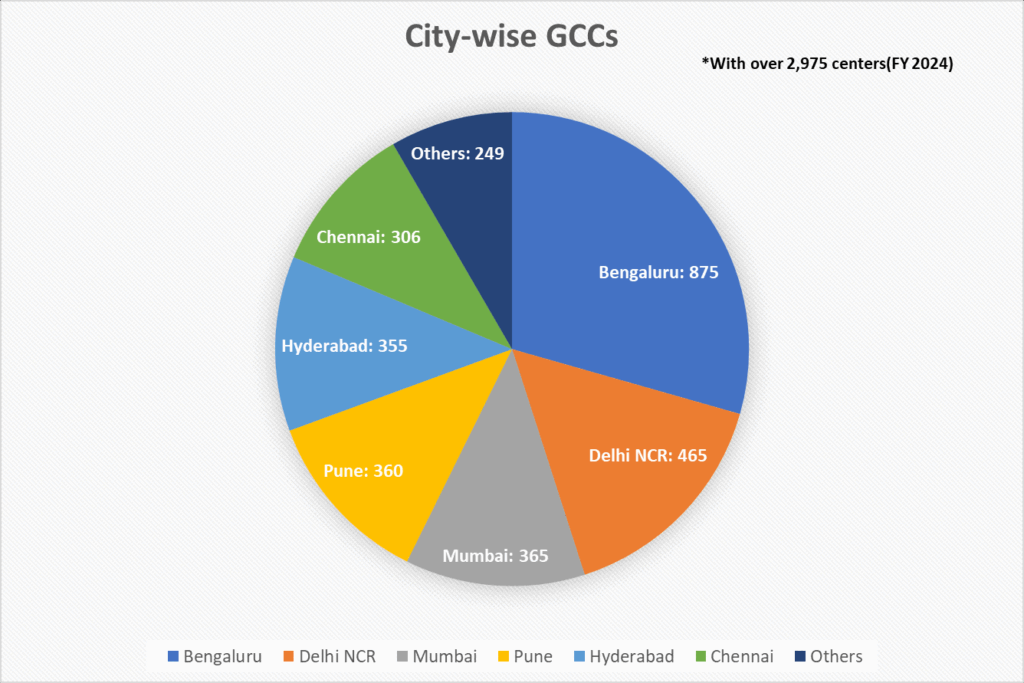
| Bengaluru | Foundational tech leadership (875 GCCs), Semiconductor design, product development |
| Chennai | Automotive engineering, pharma (AstraZeneca world’s largest GCC),logistics R&D |
| Pune | Software R&D, emerging tech, engineering services |
| Mumbai | BFSI leadership, capital markets, corporate HQs |
| Emerging Tier II | Coimbatore(cost-effective mid-market) Vizag (backed by 10,000 job ANSR campus), GIFT City (fintech/ IFSC advantage) |
Recent EY research on India’s GCCs finds that about 58% of centres are already investing in agentic or advanced AI, while most of the rest plan to ramp up within a short horizon, showing that India’s GCCs are becoming global AI and digital transformation engines rather than cost centre extensions.
Conclusion
A structural change is clearly depicted by the data of 2025, but for an investor or policy analyst, it was a noticeable and significant shift, Hyderabad along with a small number of other cities are no longer competing only on costs but are also seen as having good quality of personnel, active cooperation of various sectors and government assistance, and the presence of foreign companies that are operating Indian GCCs for their core platform, AI/ML pipelines and global strategic decision systems.
Written by Yatheendra N