
Synopsis: This article lists out the top 5 states having the largest share of development projects according to the project cost, which will also comprise the major projects in those states, their cost, and significant characteristics of the projects.
India’s development push is gaining momentum, with infrastructure and urban projects increasingly concentrated in a few leading states. Here are the Indian states with the highest share of development projects, driving economic growth, jobs, and long-term investment opportunities.
Maharashtra
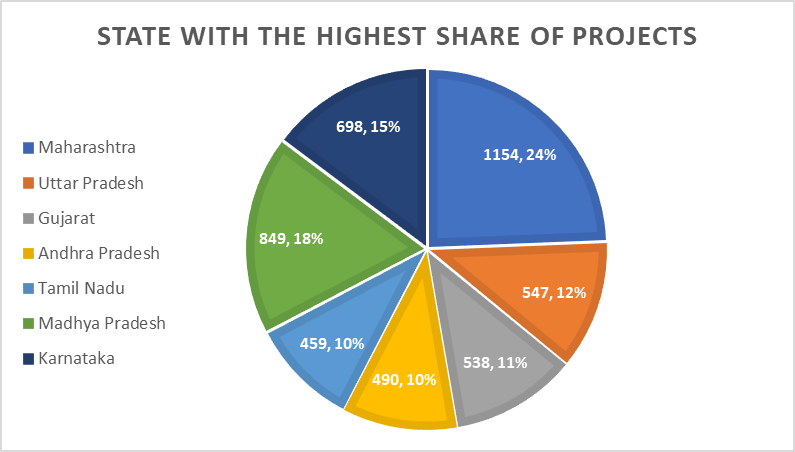
Maharashtra development portfolio looks heavily concentrated in transport infrastructure, accounting for approximately 70% of the major project cost. The top Projects are:
- Mumbai Trans Harbour Link (Atal Setu): It takes ₹17,843 Crore for a 21.8 km ocean bridge linking Sewri to Navi Mumbai, finished in January 2024. This remarkable construction project not only improves but also makes the whole of Mumbai and the Navi Mumbai area more connected and thereby more accessible for trade and commerce activities.
- Mumbai Coastal Road Project: The overall expenditure would be ₹12,721 Crore (Phase 1), a highway of 29.2 km, with 8 lanes along the western coast, linking Marine Drive to Kandivali, which will be operational in stages starting from the year 2024.
- Samruddi Mahamarg: This project consists of a 701 km expressway that connects cities like Mumbai and Nagpur with new and better means of transportation at a price tag of ₹6,595 Crore. The project is fully complete and operational as of June 2025.
Uttar Pradesh
Uttar Pradesh shows a very different and broad distribution of investments, with railways at 40%, power generation at 30%, and road infrastructure at 20%, which are the principal investment areas, thus indicating its importance for industry and agriculture. Top Projects are
- Mathura to Jhansi 3rd Railway Line: The price for a project that will create a 273.80 km long triple-track railway in the north-south corridor with better freight and passenger capacity is estimated at ₹5,323.39 Crore.
- Bhatni-Aunrihar Railway Electrification: It costs of ₹2,529.46 Crore, a Railway line electrification spanning 125 km, improving operational efficiency, and reducing emissions.
- Khurja Super Thermal Power Project: The THDC India Limited is a thermal power generation facility addressing energy requirements with an investment of ₹13,276.16 crore.
Also read: Top 10 Tier-2 Cities in India with the Fastest-Growing IT Hubs in 2026
Gujarat
The development plan of Gujarat focuses on industrial corridors and SEZs, with around half of the investments going to the infrastructure of manufacturing and logistics. Top Projects are:
- Delhi-Mumbai Industrial Corridor (DMIC) and Dedicated Freight Corridor (DFC): It has a huge investment potential of USD 90 billion, of which 36% corresponds to the 1,504 km Western DFC passing through Gujarat, 565 km, hence enabling great industrial and logistics with six nodes that include the Ahmedabad-Dholera corridor as the most prominent.
- Ahmedabad-Mumbai High-Speed Rail (Bullet Train): A connectivity project of international standards connecting the two major metropolitan areas of western India, and enhancing regional integration and the value of real estate in the area. The estimated cost of the project is about ₹1.08 lakh crore, with 81% of the funding from JICA, approximately ₹88,000 crore. Indian funding is 19% of the total, with the Central Government contributing 50% and the two State Governments 25% each.
- GIFT City (Gujarat International Finance Tech City): An eco-friendly tech financial hub giving a new positioning to Gujarat as a global financial services destination, with a potential of substantial real estate development through a project cost of ₹6,200 crore, with an expansion plan.
Andhra Pradesh
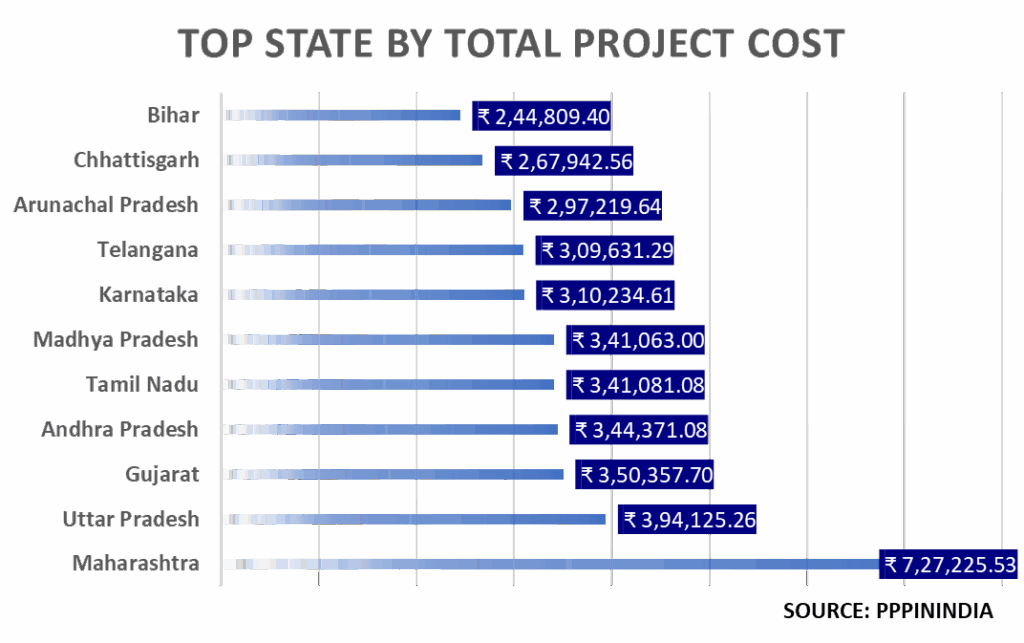
Andhra Pradesh places its highest emphasis on the development of transport infrastructure, where the major project costs are primarily made up of roads and highways, constituting around 70%, along with heavy investments in water resources. The top Projects are:
- Hyderabad-Karimnagar-Ramagundam Road Four-Laning: Project cost of ₹1,358.19 Crore, The development of a four-lane highway enhancing the connectivity among the main commercial centers, a project being executed by APRCL.
- Hyderabad-Guntur Four-Laning: AP spends ₹504.71 Crore on improving a four-lane road from km 239.710 to km 288.750, thus facilitating better inter-city communication.
- Narketpally-Addanki-Medarametla Road Four-Laning: The total cost is ₹1,196.84 Crore, aimed at creating a four-lane highway that would not only link commercial and agricultural areas but also enhance overall connectivity.
Also read: 15 Mega Infra Projects Under PM Gati Shakti That Will Transform India by 2028
Tamil Nadu
Tamil Nadu’s development strategy, giving consideration to its participation in the production and IT services sectors, reflects the 45% share of industrial corridor development, 30% of urban infrastructure modernization, and 25% transport networks. The Top projects are:
- Industrial Corridor Network: Chennai-Bengaluru Industrial Corridor (CBIC), an enormous amount of $181 billion was expected for infrastructure development over 20 years, starting from 2015, Chennai-Kolkata Industrial Corridor (CKIC), and Mumbai-Chennai Corridor.
- The Smart Cities Mission: Tamil Nadu comprises eleven municipal corporations with a total budget of about ₹106.39 billion (₹10,639 crore), which is mainly provided by the Smart Cities Mission (SCM) funds of the central government.
- The Chennai Metro Rail Phase II project: With a total estimated cost of approximately ₹63,246 Crores, it is the most significant expansion of Tamil Nadu’s metro system. The metro system will cover 119 km and 128 stations across three corridors and is expected to be finished by 2028.
Conclusion
Transport and urban infrastructure are the main focus of India’s leading states, with Maharashtra and Andhra Pradesh leaning towards large transport corridors, while Karnataka and Telangana are investing most of their budget in urban/metro projects. On the other hand, Tamil Nadu and Gujarat are the two states giving industrial allocations the most priority, while Arunachal Pradesh and Chhattisgarh are significantly more power-heavy, thus demonstrating how each state is taking advantage of its economic and geographic strengths in order to grow.
Written by Yatheendra N