
Synopsis: A prominent FMCG and edible oil major has slipped sharply from its 52-week peak, even as both foreign and domestic institutional investors have pared back their holdings over the past two quarters. What’s driving the caution?
Institutional investors don’t reduce stakes without reason. When both FIIs and DIIs trim their holdings in the same quarter, in a stock trading well below its yearly high, it usually signals underlying concerns about near-term earnings visibility, balance sheet stress, or sector-specific headwinds. This is exactly the pattern playing out in one of India’s largest diversified FMCG and edible oil companies.

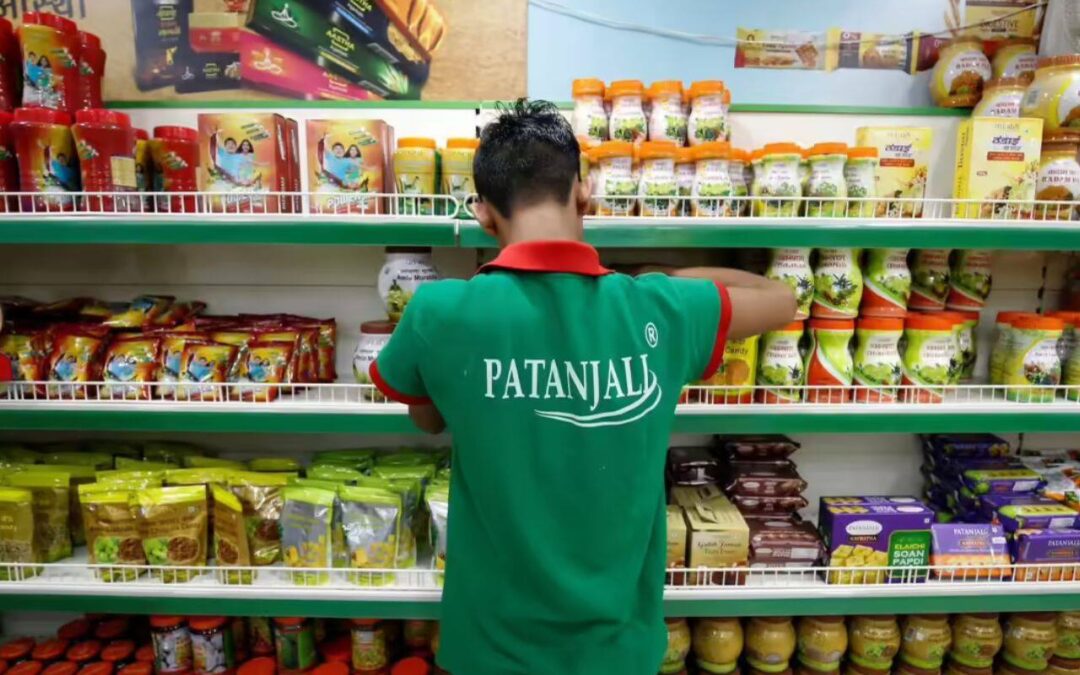
Patanjali Foods Ltd. is currently trading around ₹335, nearly 48% below its 52-week high of ₹653.93 touched on July 22, 2025. The company has a market capitalisation of ₹36,451 crore and trades at a P/E ratio of 20.82.
Shareholding Shift Tells a Story
FII holding fell from 9.20% to 8.53% between March and June 2026, while DII holding dropped from 12.06% to 11.05% in the same quarter – a reversal after both categories had been steadily rising through 2024 and 2025. Public shareholding rose from 10.49% to 12.16% over the same period, absorbing much of what institutions offloaded. Such a synchronized institutional retreat, alongside a stock trading near half its 52-week high, rarely happens by coincidence.

Profit Margins Under Pressure Despite Record Revenue
FY26 saw the company cross ₹40,000 crore in revenue for the first time, backed by double-digit growth across edible oil and FMCG segments. But the headline number hides a weaker underlying picture. Full-year EBITDA margin stood at 4.79%, and in Q4 it slipped further to 4.48%, with profit before tax margin at a thin 2.10% for the quarter. Revenue growth is clearly outpacing profit growth, and for institutions tracking earnings quality, this widening gap is often an early red flag.\\
Sharp Rise in Edible Oil Costs Hit Earnings
The edible oil business, the company’s largest revenue driver, faced a steep cost environment through the quarter. RBD palm and deodorized palm oil prices rose an estimated 20% between January and March 2026, while refined soy oil climbed around 23%, both driven by crude volatility tied to geopolitical tensions and tighter global supply.

Packaging, freight and insurance costs added further pressure, pushing cost of goods sold up 98 basis points sequentially and 294 basis points year-on-year. Even with near-total cost pass-through, the segment’s EBITDA margin came in at just 2.58%, near the lower end of the company’s own 2-4% target band.
Foods Business Witnessed Weak Demand
The Foods segment told a more concerning story, with management flagging a sharp sequential revenue decline of nearly ₹400 crore, driven by weakness in staples (particularly rice) and a seasonal dip in ghee sales linked to early summer onset and Middle East-related disruption.
On a 12-month basis, staples revenue alone was down close to ₹98 crore. Management also flagged two forward-looking risks: potential El Niño-linked drought conditions affecting crop categories, and possible shifts in government policy around staples. While the company expressed confidence this weakness is largely behind it, the segment’s volatility appears to be a factor institutions are weighing carefully.

Borrowings and Receivables Increased
A less visible but equally important concern shows up on the balance sheet. Amid an uncertain market environment, the company extended significantly higher credit to customers, with receivables rising an estimated ₹700-800 crore. Simultaneously, it made advance payments to vendors to secure raw material supply, pushing borrowings higher.
Management has acknowledged this departure from its usual cash-basis procurement and expects to normalize both receivables and advances over the next one to two quarters, geopolitical conditions permitting. Until then, rising working capital needs and debt levels – coinciding with compressed margins – are exactly the kind of signals that tend to make institutional investors cautious.
Geopolitical and Commodity Volatility Remain Key Risks
Beyond company-specific factors, management was candid about broader risks clouding the outlook: volatile crude oil prices, Indonesia’s proposed centralization of palm oil exports, ongoing global conflicts, and weather-related disruptions were all cited as factors that could continue to affect revenue and margins in the coming quarters.
While management remains optimistic that such volatility could favor large, well-capitalized players over smaller unorganized competitors, the sheer number of moving variables adds a layer of unpredictability that institutions may be choosing to sit out rather than underwrite at current valuations.
Conclusion
Taken together, the numbers point to a company scaling revenue while margins, working capital, and demand visibility all come under strain simultaneously. Compressed edible oil margins, staples weakness, rising receivables and borrowings, and external risks like El Niño and Indonesia’s export policy have given institutions reason to trim exposure. Whether this proves temporary or a longer de-rating will depend on how quickly the company restores margin discipline and balance sheet strength in the coming quarters.
Disclaimer: The views and investment tips expressed by investment experts/broking houses/rating agencies on tradebrains.in are their own, and not that of the website or its management. Investing in equities poses a risk of financial losses. Investors must therefore exercise due caution while investing or trading in stocks. Trade Brains Technologies Private Limited or the author are not liable for any losses caused as a result of the decision based on this article. Please consult your investment advisor before investing.