
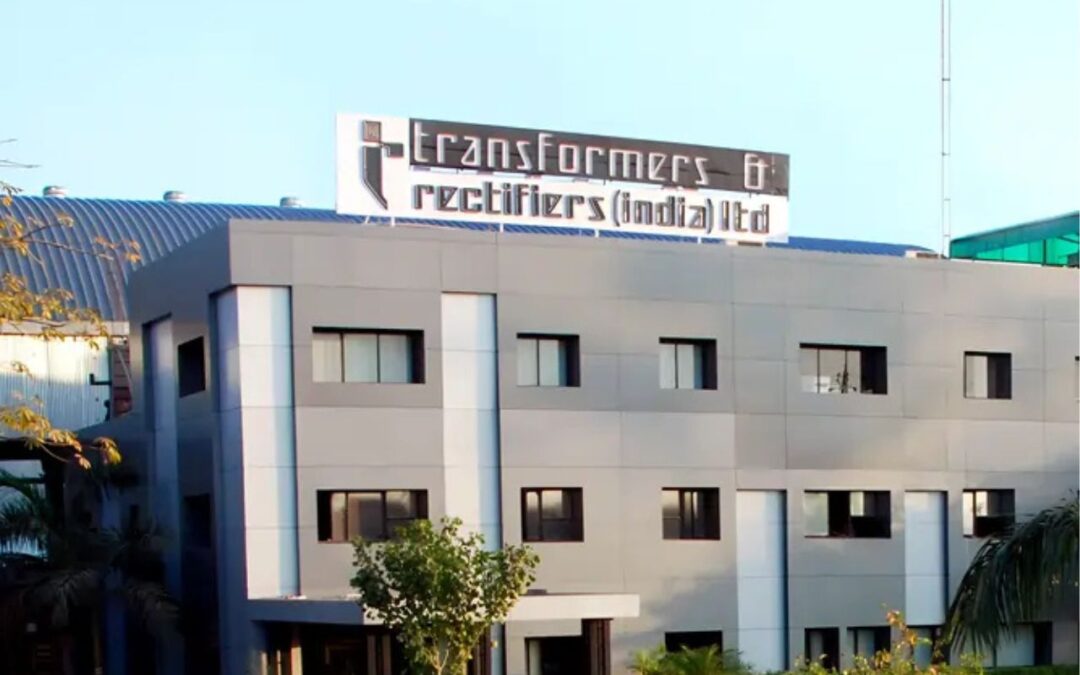
Synopsis: A leading transformer manufacturer saw its stock slide 5% after Q1 profit fell 17% year-on-year, even as revenue grew and the order book crossed ₹6,630 crore. The management attributed the weakness to a temporary capacity crunch tied to ongoing expansion work.
Even a strong order book and a fresh billion-rupee win from a state utility weren’t enough to cheer investors this week. Shares fell sharply after quarterly profit came in lower than expected, with the company blaming reduced plant capacity during an ongoing expansion for the miss. The bigger question now is whether the order pipeline can carry growth once the expansion wraps up.

With a market capitalization of around ₹9,505 crore, shares of Transformers and Rectifiers India Limited (TARIL) were trading at ₹317, with a 52-week range of ₹578.50 to ₹224.05, and they are trading at a P/E of approximately 37.
Q1 Numbers Tell a Mixed Story
On a consolidated basis, revenue rose 8% year-on-year to ₹572 crore, though it was down 27% sequentially from ₹783 crore in Q4FY26. Other income came in lower too, at ₹16 crore against ₹20 crore a year earlier, taking total income to ₹589 crore, up 7% YoY but down 27% QoQ.

EBITDA grew just 1% YoY to ₹110 crore, and fell 22% QoQ from ₹141 crore in the previous quarter. The EBITDA margin slipped to 19.2% from 20.5% a year ago, and was also lower than the 18–20.5% range seen in the trailing quarters. Profit before tax fell 3% YoY to ₹88 crore, down 26% QoQ from ₹119 crore. PAT declined 5% YoY to ₹64 crore, a steeper 29% drop sequentially from ₹91 crore in Q4FY26.
The company attributed the decline in performance to reduced capacity utilization at its Changodar plant, identifying it as the primary factor. Ongoing expansion efforts at the facility resulted in diminished operational throughput during the quarter, which directly impacted margins and profitability. This trend is evident in both the year-on-year softness and the more pronounced quarter-on-quarter decline, particularly as Q4 generally experiences a seasonal revenue increase that Q1 does not replicate.

The Order Book Tells a Different Story
Set against the soft quarterly numbers is a much healthier order picture. The company closed the quarter with an unexecuted order book of ₹6,630 crore, up 26% from ₹5,246 crore a year earlier. That gives it revenue visibility stretching 18 to 24 months out, and management has said existing capacity is adequate to execute what’s already on the books.
Fresh order inflow during the quarter was strong too, at ₹2,114 crore, more than triple what came in during the same period last year. The standout win was an order worth more than ₹1,000 crore from Power Grid Corporation of India, spanning transformers of various ratings to be delivered over 30 months. Other orders came in from state utilities including GETCO and RRVPNL, along with an export order from the US.
Beyond the confirmed order book, the company also has a ₹23,000 crore pipeline of inquiries under negotiation. Historically, win rates on such inquiries have run between 10% and 15%, so not all of it will convert, but even a modest share landing as firm orders would add meaningfully to the pipeline over the coming years.

Expansion Now, Payoff Later
The capacity crunch that dented this quarter’s numbers is expected to be temporary. Management has said the Changodar expansion should be complete by August 2026, after which utilisation levels should improve and support stronger execution in the quarters ahead.
The company isn’t stopping at just restoring capacity, though. It’s investing ₹150 crore in expanding the Changodar plant further and a much larger ₹900–1,000 crore in backward integration, aimed at manufacturing more of its own components in-house, such as bushings, tanks, and core materials.
The idea is to reduce dependence on outside suppliers, protect margins from raw material cost swings, and gain tighter control over delivery timelines. Commercial commissioning of these backward-integration facilities is targeted by the first quarter of FY28, with some delay already factored in.
Funding for this capex is expected to come from a mix of leftover proceeds from a 2024 QIP, leasing arrangements, internal accruals, and debt if required. For FY27, management has guided for 25% revenue growth, with EBITDA margin around 16% and PAT margin between 9% and 10%.
Conclusion
This was a quarter where the near-term numbers and the underlying business story pulled in different directions. Profit shrank because of a plant that’s mid-renovation, not because of weakening demand. If anything, demand looks stronger than ever, with the order book and inquiry pipeline both pointing to years of visible work ahead, backed by India’s ongoing push on power transmission and renewable energy infrastructure. Whether the market comes around to that view will likely depend on how quickly the Changodar plant gets back to full strength.
Disclaimer: The views and investment tips expressed by investment experts/broking houses/rating agencies on tradebrains.in are their own, and not that of the website or its management. Investing in equities poses a risk of financial losses. Investors must therefore exercise due caution while investing or trading in stocks. Trade Brains Technologies Private Limited or the author are not liable for any losses caused as a result of the decision based on this article. Please consult your investment advisor before investing.