
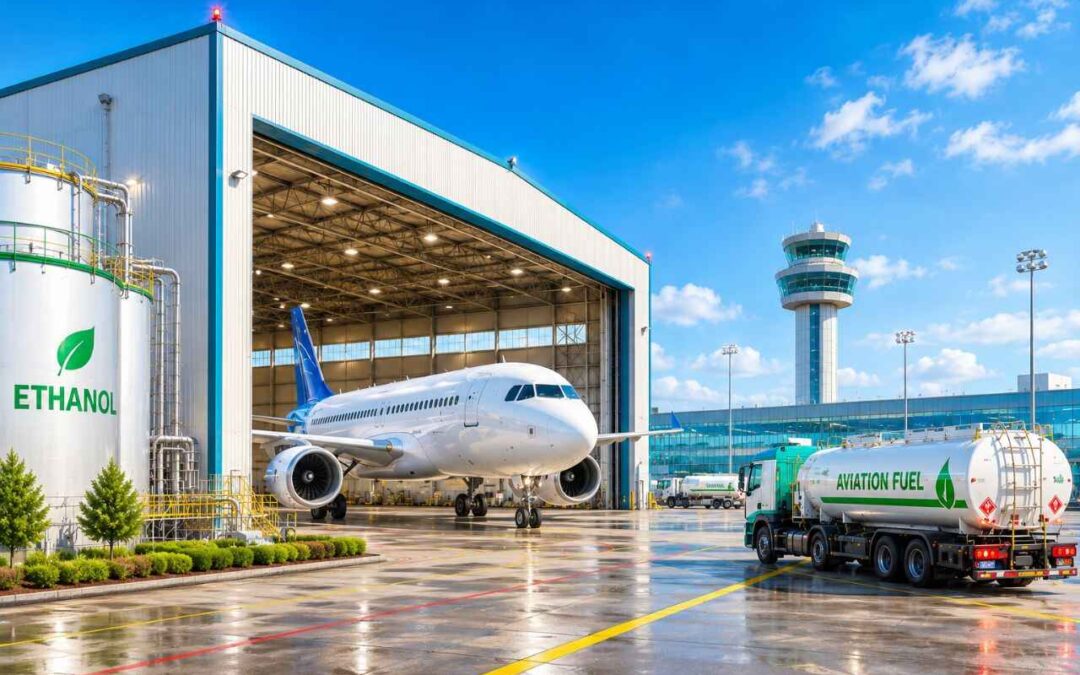
Synopsis: TruAlt Bioenergy is India’s largest ethanol producer by installed capacity. But with ethanol allocations and utilization emerging as key challenges, the company is now betting on a new opportunity that could reshape its future. Why is TruAlt building a Rs. 2,250 crore aviation fuel business?
India’s energy transition is no longer only about electric vehicles or solar power. The country is also trying to reduce its dependence on imported crude oil by increasing the use of biofuels. Ethanol blending in petrol has already become a major part of this journey, while compressed biogas and sustainable aviation fuel are emerging as the next big opportunities.

This is where TruAlt Bioenergy enters the picture. The company is already India’s largest ethanol producer by installed capacity, but it is now trying to move beyond being just an ethanol manufacturer. Its bigger ambition is to become an integrated biofuel platform with ethanol, compressed biogas, sustainable aviation fuel and retail fuel outlets forming different parts of the same business model.
The most interesting part of this transition is its plan to build a sustainable aviation fuel plant in Andhra Pradesh with an investment of up to Rs. 2,250 crore. At first, this sounds unusual. Why would an ethanol company build aviation fuel capacity? But the answer lies in TruAlt’s current business model, its ethanol capacity, the challenges it faced in FY26, and the company’s plan to create a second demand source for its own ethanol.

What Does TruAlt Bioenergy Actually Do?
TruAlt Bioenergy is mainly a biofuels company. Its core business today is first-generation ethanol, which is supplied for blending with petrol. The company has five ethanol distilleries.
Earlier, ethanol manufacturing was heavily linked to the sugar cycle. This means operations were more seasonal and depended on the availability of sugarcane-based raw materials. TruAlt has been trying to change this structure. During FY26, the company completed the commissioning of all five ethanol plants and also shifted from being a mono-feed operator to dual-feed operations in three out of its five plants.

This is important because dual-feed operations allow the company to use different raw materials. Instead of depending only on one feedstock, TruAlt can use sugar-based as well as grain-based inputs. In simple words, the company is trying to make its ethanol plants run for a longer part of the year, with better flexibility and better protection against raw material price movements.
But ethanol is no longer the only business. Its product portfolio includes ethanol, CBG, DDGS, extra neutral alcohol, CO2, fermented organic manure, liquid fermented organic manure, biofuel dispensing stations and proposed products such as SAF, 2G ethanol, mevalonic acid and high-value by-products.
The Ethanol Business And The Problem Of Utilisation
TruAlt has built a large ethanol platform. Management said the company has ethanol production capacity of around 55 crore to 60 crore litres on a 300 to 330 operating day cycle. On paper, this gives the company a very strong base. However, FY26 showed that having capacity and using capacity are two different things.

For the ethanol supply year 2025-26, TruAlt bid for around 72 crore litres, considering peak production capacity. But it received allocation of only around 26 crore litres from public sector oil marketing companies. This was only around 34 percent of the quantity it had bid for. It also received around 8 crore litres allocation from private oil marketing companies, Reliance and Nayara and planned around 6 crore litres of extra neutral alcohol sales.
This meant visible volumes were much lower than the company’s full production potential. Management said that the company was running at only around 2.2 crore litres of ethanol sales per month, against a production capacity of around 6 crore litres per month. This means utilisation was below 35 percent.
This is the biggest reason why the SAF project becomes important. TruAlt is not only trying to enter a futuristic fuel market. It is also trying to solve a very practical business problem: what to do with excess ethanol capacity if oil marketing companies do not lift enough volumes.
Why Sustainable Aviation Fuel Matters
Sustainable aviation fuel is a cleaner aviation fuel that can be blended with normal air turbine fuel. Aviation is difficult to decarbonise because airplanes cannot easily shift to batteries like cars or scooters. This makes SAF one of the few scalable solutions for reducing emissions in the aviation sector. For TruAlt, SAF has two advantages. First, it opens a new high-value market. Second, it can consume the company’s own ethanol.
Management has said that TruAlt has signed an MoU with the Government of Andhra Pradesh to set up a 10 crore litre per annum SAF plant. The company has also identified a land parcel that is around 8 kilometres away from a seaport with a liquid terminal, around 110 kilometres from the IOCL Paradip refinery, around 130 kilometres from HPCL’s Vizag refinery and around 60 kilometres from the upcoming international airport at Bhogapuram.
This location is important because SAF needs strong logistics. The fuel can be supplied to refineries for blending, directly to airports, or even exported. The site also has access to railway rakes, which further improves logistics.
The company has also signed a technology transfer agreement with Honeywell UOP and is in advanced stages to begin front-end engineering work. It is also working on long-term offtake contracts with three types of customers: airline carriers, aircraft manufacturers and oil and gas companies.
Management has said that once long-term offtake agreements and pricing are finalised, the company will take the final investment decision and start ground mobilisation. So the SAF plan is not just a random diversification. It is linked to ethanol, logistics, technology, customer contracts and utilisation.
The Rs. 2,250 Crore Question
TruAlt said it has entered into an MoU with the Andhra Pradesh government for an investment of up to Rs. 2,250 crore for an ethanol-to-SAF plant. It also said that this could position TruAlt among the largest global producers of ethanol-derived SAF.
The business logic is simple. If TruAlt can divert around 20 crore litres of ethanol from its current capacity into the SAF vertical, it can improve utilisation in its ethanol business and create another revenue stream. Management has clearly said that SAF can help the company operate its current ethanol capacity at full capacity by diverting 20 crore litres out of 60 crore litres of ethanol to the SAF business.
This matters because ethanol is still dependent on government allocation, OMC offtake and blending policies. SAF can reduce this dependence over time by creating a new set of customers, including airlines and oil and gas companies.
In Q3FY26, management also indicated that SAF revenues could start in FY28, with commercial production expected around July to October 2027. On pricing, management said that while policy clarity was still awaited, global SAF prices were higher than air turbine fuel, and TruAlt was estimating a possible SAF sale price of around Rs. 180 to Rs. 200 per litre. It also said the company was looking at 20 percent to 25 percent EBITDA margin in SAF based on its economic assessment.
CBG And Retail Add More Layers
While SAF is the most exciting future story, compressed biogas is already showing strong numbers. In Q2FY26, TruAlt said CBG revenue for H1FY26 grew to Rs. 20.71 crore from Rs. 12.53 crore in H1FY25. The CBG EBITDA margin stood at 68.29 percent, while PAT improved to Rs. 10.13 crore.
By Q3FY26, the CBG business had delivered an EBITDA margin of 63 percent and PAT margin of 43 percent for the nine months ended December 2025. This showed that the CBG model was not just a concept but already financially meaningful.
The company is also scaling CBG through partnerships. Sumitomo Corporation is a 49 percent partner in TruAlt Gas, while GAIL has infused equity and holds 49 percent in Leafiniti Bioenergy. TruAlt wants to increase its CBG capacity from 10 tons per day to 162 tons per day through multiple plants. This can become an important bottom-line driver.
Retail fuel is another small but strategic piece. TruAlt has received oil marketing company status and has already commissioned seven retail outlets under a franchise model without investing capex. These outlets are generating over Rs. 100 crore revenue with around 5 percent EBITDA. The company has four more outlets under commissioning and has shortlisted 76 additional locations, although it is moving slowly because of crude price volatility.
Conclusion
TruAlt Bioenergy’s Rs. 2,250 crore aviation fuel plan is not just about entering a fashionable green energy segment. It is part of a much larger strategy to move from being an ethanol producer to becoming a complete bioenergy company.
The company already has large ethanol capacity, but FY26 showed that capacity alone is not enough. Utilisation depends on allocation, offtake and market prices. SAF can become a way to use its own ethanol internally, enter a higher-value fuel market, and reduce dependence on only one revenue source.
If TruAlt executes well, the company could have four engines: ethanol as the base business, CBG as a high-margin growth driver, SAF as the future opportunity, and retail fuel outlets as the downstream link. But the path is not risk-free. The SAF project still needs final investment decision, offtake agreements, policy clarity, funding and execution.
Disclaimer: The views and investment tips expressed by investment experts/broking houses/rating agencies on tradebrains.in are their own, and not that of the website or its management. Investing in equities poses a risk of financial losses. Investors must therefore exercise due caution while investing or trading in stocks. Trade Brains Technologies Private Limited or the author are not liable for any losses caused as a result of the decision based on this article. Please consult your investment advisor before investing.